
Remarks to the DFHS Graduating Class of 2015

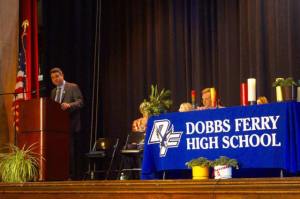
The following remarks were made to the DFHS Class of 2015 at our commencement on June 20, 2015. The full graduation can be viewed by clicking on the following link: 

http://www.dfsd.org/site_res_view_folder.aspx?id=bb7619cb-22c0-46a6-89c0-13dc927db8e9

To the Board of Education, Superintendent Brady, Mr. Berry, Administration, Faculty members, Parents, Family members, Friends, Students, and Graduates: Good evening, and welcome to the Dobbs Ferry High School Commencement of 2015. Tonight we are saying congratulations and goodbye to the first graduating class that I had the privilege of watching grow, mature, and succeed for all four years at Dobbs Ferry School. It has truly been an honor to be your principal, and I’m so proud of all that you have accomplished as students and citizens. I know I speak for all our faculty and staff at the high school when I say, “congratulations graduates on a job well done!

Since the first day of your freshman year, the faculty of Dobbs Ferry High school has been committed to providing the tools necessary for your success beyond the walls of our school. Your education has challenged you to ask the right questions, and to never quit searching for better answers, to think globally and act locally, and to use creativity, communication and compassion to leave this world in better shape than you found it. In addition to the immeasurable efforts of your teachers, there have been a few others who are worthy of gratitude this evening for helping you along the way. It was those individuals who cheered for you from the sidelines to score that last minute goal, the people who made sure that you ate and got some sleep when you were cramming for exams, the ones who drove you to music lessons, and the ones staying up to make sure you get home safely on a Saturday night. Today, your great achievement is shared in equal measure by the joy, sacrifice, and love of your parents and families. As is tradition, I would like to ask all of you, our graduates, to please stand and give your parents and families a round of applause for the tireless sacrifice and support that they have given throughout your life.

I would also like to thank the wonderful administration and faculty of DFHS who are tireless in their efforts to inspire, encourage, and support all our students each and every day. The commitment and dedication of our staff is second to none, and we all take great personal pride in the accomplishments of each graduate who is sitting here today.

Each year, we welcome new staff members to our school and, in some years, sadly say good-bye to others who retire from our district after many years of dedicated service. This year, we say goodbye to Mr. Jim Lindsay, who will retire after a lifetime spent in the Dobbs Ferry School District. Coach Lindsay graduated from Dobbs Ferry High School in 1970 and still holds the school record in both the 100 meter high hurdle and the Sprint Medley Relay. Upon graduating from Cal State, Coach Lindsay came back to his roots in Dobbs Ferry. He has taught in the district for past 26 years while serving as our Athletic Director for the past 11. In addition to coaching Track and Cross Country for the past 33 years, and coaching varsity basketball for 16 years, he was a member of the football coaching staff for 30 years and was part of 8 state champion football teams. Coach Lindsay is a passionate educator and coach who touched the lives of so many students in Dobbs Ferry during his lifetime. As he often says, he bleeds blue and white, and he has created a legacy in Dobbs Ferry that will carry on for future generations. We thank Coach Lindsay for all of his service, and wish him the very best in the next phase of his life. Please join me in providing a round of applause to Coach Lindsay.

When I look around today I can’t help but feel nostalgic. I remember so clearly when we were introduced for the first time by Mr. Mussolini at your 8th grade Stepping Up Ceremony. You had the wide-eyed look of excited graduates, along with a nervous energy of what the next four years would hold…what it would be like to be a student at Dobbs Ferry High School. In many ways I had the same feelings of uncertainty. And as we walked the same halls for the first time, and continued to do so over the past four years, I have been honored to watch all of you grow from a group of wide eyed kids to a collection of truly wonderful and capable adults. I’d be lying if I didn’t say that this class will always hold a special place for me, and not surprisingly this graduating class has helped to bring our school to new heights in so many areas, along with several Dobbs Ferry High School firsts…Sitting before us today,

  • We have 36 students who will receive a full IB Diploma, an all-time high for DFHS, with each student in the graduating class having taken an average of 3 IB courses at DFHS.
  • We have 13 science research students who won awards at WESEF, along with students who have placed in numerous competitions at the local, national, and even international level.
  • We have the third class of seniors who have taken the Blue Star Financial Literacy exam and have helped to give our school yet another Blue Star distinction, with four students receiving a gold star distinction, a first for our school.
  • We have the state champion in the track and field steeple chase, the first in our school’s history.
  • We have the first group of seniors who produced a yearbook through our new yearbook class and, as a result, we are now primed for many future awards and accolades.

And in addition to the many the firsts, this graduating class has also continued the long standing tradition of excellence to which we have grown accustomed at Dobbs Ferry High School. Sitting before us today, we also have…

  • 50 students who will be awarded an Advanced Regents Diploma by NYS.
  • We have IB Film students who continue to produce films that the capture the spirit, creativity, and history of our school and community.
  • We have actors and actresses who put on a rousing rendition of Little Shop of Horrorsin front of a packed house, and performers who earned area all-state distinction in chorus and orchestra.
  • And we have students who have participated in numerous fundraisers and community service projects, including volunteer work for the American Cancer Society, the NYS Hudson Valley Blood Drive, Pets Alive Animal Shelter, and of course our most recent penny wars fundraiser to raise money for research to cure Neuroblastoma.

And that of course this is only a small part of the story. The students in this year’s graduating class have truly left their mark on bettering the world around them due to the great work that they are doing in our Dobbs Ferry community.

As I sat down this afternoon to put the finishing touches on this address, I took a look at some of the old yearbooks from our school’s history. Coach Lindsay had every yearbook from 1941 to the present in his office, and they are now proudly showcased in the principal’s office of our high school. I invite you to come by to take a look so that you may get a sense of our school’s proud history. And as I looked through the pages of our many yearbooks, I was reminded that while the world has changed so much since the first class of students that graduated in Dobbs Ferry all the way back in 1857, what has remained consistent is that our school continues to produce proud graduates who have made a positive difference in the world throughout history. To all our graduates, you are now part of that proud history, and the great things that you go out and do will build upon a history and legacy of Dobbs Ferry graduates for future generations of students.

So what’s next? What are you going to do after this? Who do you want to be? As your journey takes you beyond the doors of our school and onto your future the answer to “what’s next” is totally up to you…but as for the “who do you want to be?”… I do have one simple piece of advice: when you leave here, don’t just find good people to ask advice of, instead be the person that others come to for good advice. When you go off onto your next steps, no matter where they may lead, be someone deemed trustworthy by your peers, take smart risks, be open-minded in all that you do and toward all that you meet…and above all, demonstrate kindness and humanity. The answers to those intimidating questions about what you want to do with your life will come. For some it will come quickly and for others it could take much longer, but the future title on your business card or LinkedIn profile is not a definer of success.  When you are a good person, a good friend, and a good daughter or son, you become someone others wish to know, a person with opinions that others value, and an individual who others will ask advice from…not because you get everything right, but because you endeavor to do what is right. That is a successful individual.

So when someone asks you “Who or What do you want to be?”…if your first thought is “a good person,” then I’d say you are making all the right choices. Don’t get me wrong…our world could definitely use some more doctors, researchers, actors, journalists, and even meteorologists, but above all, what this world needs is more good people. And I’m proud to say that when I look around today, I see a whole graduating class full of them, and am certain that this group of graduates will go out and add to the tradition of excellence that has been typical of so many Dobbs Ferry graduates for over a 150 years.

Thanks to each of you for an amazing four years. We had a great ride, and I will miss you dearly. Congratulations to all of you, the Dobbs Ferry High school class of 2015.


National Honor Society Induction (Opening Remarks)

The following opening remarks were made at the 79th National Honor Society induction at DFHS on May 28, 2015.

Good morning. On behalf of the administration and faculty of Dobbs Ferry High School, I would like to welcome all of you to the 2015 Dobbs Ferry High School Honor Society Induction. Before getting started, I would first like to thank our honor society advisors: Mr. Cottingham (NHS), Ms. Addona (Italian), Ms. Sardinia (Spanish), and Ms. Irvine (French). A special thanks also goes to all of the parents who are in attendance this morning as well as our current Honor Society members who took the time from their internship to be with all of us today. I would also like to recognize  BOE member Robert Reiser who is in attendance this morning.

This morning we have students who are being inducted into at least one, and in some cases two, honor societies. They are the Italian Honor Society, the French Honor Society, the Spanish Society, and of course the National Honor Society. Admission into any one of these Honor Societies is an extraordinary accomplishment, and is a recognition of the years of hard work and service of the students in this room.

So what does it mean to be a member of an Honor Society? We know at a minimum that it means to maintain the exemplary grade point average that is required for admission. And while we as a society always place a strong emphasis on academic performance, we also know that the world is filled with many smart people who don’t always demonstrate the morals and ethics that are at the very core of what it means to be a member of an honor society. As Honor Society members, you are the leaders of your class, and represent the very best of our school. The Honor Society is built on four pillars: Scholarship, Service, Leadership, and Character. You are already hitting the mark in each of these areas, and it is for this reason that you are sitting before us today.

However, the challenge that I present to you is not one that you will necessarily face today, but rather at many points throughout your life. There is nothing more important and honorable than hard work. I think that I’ve instilled this message in all of you during your time at DFHS, and I know that your teachers and parents have certainly done the same. And as you move into the final stage of high school and life thereafter, you will face many points where you need to decide between doing something the right way or doing something the wrong way. The moment is sometimes subtle and can even be overlooked, but the choices that you make in those key moments will make all of the difference for the life that you ultimately lead. Robert Frost reminds us that “taking the road less traveled made all of the difference” for him. As you travel down your own road, my hope and belief is that each of you will always lean on the values, ethics, and character that you have developed as you make those difficult choices throughout your life. We all know that you have the necessary foundation, and it is for that reason that you being admitted to the honor society.

In closing, always remember that induction to the Honor Society is a beginning, not an end. You are all well on your way to making wonderful contributions to our world, and are well on your way to leaving a legacy that will carry on for future generations of Dobbs Ferry students. Congratulations to all of you once again. Please continue to make your school proud, your teachers proud, your parents proud, and most importantly yourself proud. Thank you.

NHS Speech

Creating Innovators: Tech Expo 2015

Last week’s Tech Expo at the Edith Macy Center in Briarcliff Manor once again proved to be an excellent opportunity to think outside of the box and to consider “what’s possible” as we move further into the 21st century. This year I had the pleasure of being accompanied by @DobbsSciRes, @PrincipalMoose, and @TeranceHuyter and, as always, I left feeling both refreshed and inspired. In addition to the many breakout sessions, the program featured an opening keynote by Dr. Tony Wagner as well as presentations by renowned thought leaders Jaime Casap and Alec Couros. The “theme” of creating students who are motivated problem solvers was present among all three speakers and each called for change and innovation to what remains a traditional and “old” educational system. There was lots of tweeting going on throughout the day (#lhrictli) and I’ve compiled a list of  twenty “tweetable” highlights that came my way. You’ll quickly notice that each prompts further thought, discussion, and in some instances debate. All are a 140 characters or less, so feel free to tweet away…

  1. The world no longer cares about what Ss know. The world cares about what Ss can DO with what they know.
  2. There was a time when teachers had “the corner” on information. That has changed today.
  3. The innovation of a creative problem solver is an innovation capability that can be developed, not born.
  4. We are born curious. Most kindergartners ask questions and think of themselves of artists.
  5. By age 12, most Ss are are just looking for the right answers to the questions. Curiosity is all but destroyed.
  6. In every case, the teacher who makes the greatest difference is the outlier–those who teach differently from his/her peers.
  7. Innovation always happens at the boundaries of academic disciplines, not within them.
  8. There is NO innovation without trial and error.
  9. The only failure that should happen in schools is the failure to show up…the failure to not try.
  10. Every student needs three things when they leave school: content knowledge, survival skills, and the most importantly the WILL to succeed.
  11. If you are intrinsically motivated, you will be able to learn and develop the skills needed to be successful throughout life.
  12. Developing the capability of grit is best learned when someone is intrinsically motivated. Not when they have “tiger moms” riding them.
  13. Google allows time for “play” called” Google time” which leads to tremendous amounts of innovation. Do schools?
  14. Employers don’t trust transcripts anymore. They provide nothing but evidence of seat time.
  15. In 2020, we are going to need about 1.4 million people for jobs in computer science, and we are only on track to graduate 400k.
  16. Challenge students with questions like “What problem do you want to solve?”
  17. Iteration is both success and failure. Google Apps updates over 200 times a year!
  18. We need digital leaders who add to the internet (blogging, etc.) and not just consume the internet.
  19. Schools that focus on iteration and innovation support the world that we now live in.
  20. Technology is not the silver bullet. It supports education. Teachers and education are the silver bullet.

Biggest Takeaway…

Computer Science and Coding: Perhaps the greatest takeaway from this year’s conference is the necessity of providing far more opportunities for students to acquire experience in computer science and coding at the high school level. @jcasap noted that in 2020, our nation will need about 1.4 million people for jobs in computer science. At this point, we are only on track to graduate 400k. For high schools that are guided by mission statements that include words such as “21st century learners” and “global citizenship” (which is pretty much all of them these days), there is an  urgency to immediately provide all students with these necessary skills since we are fast approaching a world where they will be considered “basic” and “the norm.” A robust computer science program must of course be introduced much earlier than high school and we are seeing more and more schools with programs that have students coding as early as first grade. In Dobbs Ferry we are beginning to lay the foundation for what we hope will be a leading K-12 computer science program in a few years time. In doing so, we are preparing to launch in this direction next year by participating in The Hour of Code and by investigating online computer science options that move beyond the brick and mortar of our school. Ultimately, we are looking at a comprehensive “in-house” program that spans all of our buildings. There are many challenges that all schools face, including staffing and resources, and the shift requires that school leaders employ the types of  21st century survival skills that we are seeking to develop in the students that we graduate. Iteration? For sure. Lots of it is in store. Are we up to the challenge? Stay tuned…

Authentic Intellectual Experiences: Destination Imagination

There is perhaps no hotter topic in education right now than student assessment, “opting out,” and the role that standardized tests play in the education of our students. As more and more state governments continue to push for mandated testing, the debate about whether state exams are indeed a valid indicator of what students know and are able to do is now at its peak among teachers, administrators, parents, and of course government officials. The challenge for school leaders, of course, is to maintain some sanity among the madness and to not allow top-down mandates to singularly drive decisions around curriculum and instruction.

As a Principal, it would be irresponsible of me to dismiss the importance of student performance on standardized (NYS Regents) exams at the high school level. There is too much at stake for students and, quite frankly, college admissions depend in part on student performance on Regents exams. Despite this, I am always on the lookout for “authentic intellectual experiences” that provide students with opportunities to demonstrate and apply their skills and knowledge to “real world” problems. I wrote a piece last year on our senior internship program and have also referred to programs such as the IB Diploma Program (@MegHalberg) and Science Research (@DobbsSciRes) as ideal for furthering the development of the types of 21st century “survival” skills that Wagner refers to in The Global Achievement Gap.

I was recently interviewed by a community member who is writing a piece about the Destination Imagination (DI) program at DFHS and also had the pleasure of watching my first grade daughter compete in her first DI competition in MA just last weekend. These two experiences got me thinking more about DI and, more specifically, the types of 21st century skills that are so easily assessed through the performance-based tasks that students engage in through the program. If you are unfamiliar with DI, the mission is to “encourage teams of learners to have fun, take risks, focus and frame challenges while incorporating STEM, the arts and service learning. Participants learn patience, flexibility, persistence, ethics, respect for others and their ideas, and the collaborative problem solving process.” To accomplish this, teams participate in challenges in the areas of structure, technology, science, improvisation, fine arts, or community service. The challenges not only require teamwork, but also the application of critical 21st century skills, including collaboration, communication, curiosity, imagination, self-direction, and initiative. In this sense, it is an ideal “performance-based” task that allows for the assessment of “real world” skills that could never be measured on a standardized written exam. It also provides a more comprehensive view of what students know and, perhaps more importantly, are able to do.

Drew Coburn, Dobbs Ferry parent and current Chair of Destination Imagination in New York, puts it best when he says that “DI is a model for the kind of authentic educational experiences that we need to spread like wildfire through New York schools and elsewhere. Not just because educators say so, but because CEOs say so, and government leaders, and successful entrepreneurs and scientists.” Drew is spot-on in his assessment and schools throughout the state are joining him in this viewpoint as programs such as Destination Imagination continue to grow. In Dobbs Ferry, we believe that we must have “something for everyone” so that we can maximize the potential of all students. DI is one program that helps us to do just that while providing us with an “authentic” vehicle for assessing our students outside of formal standardized assessments. My hope is that more schools across NYS (and nationally) will join in this mission and make it part of the instructional program for all students.

Gearing Up For The Job Search: The Demo Lesson (Updated!)

As the end of the school year quickly approaches, the job search is in full swing as districts everywhere are beginning to interview candidates for the 2015-16 school year. It’s no secret that jobs in education are tough to come by these days. School districts typically receive well over two hundred resumes for any given position and it’s getting tougher and tougher just to get a foot inside the door. If you’ve gotten a call and have successfully made it through both a screening and a committee interview (see post on 3/6/15), you are now one of a few remaining finalists and are likely preparing to teach a demonstration (“demo”) lesson. If this is you, congratulations! You’re doing well. But don’t start celebrating just yet. There’s still a lot of work to do.

In many ways, the demo lesson is the most important aspect of the interviewing process. This makes good sense since it is the one and only opportunity to show that you can actually teach. I’ve observed hundreds of demo lessons over the years and have seen candidates who have completely blown it and others who truly transformed when placed in front of students. Simply stated, it’s the phase where jobs are won and lost.

So as you prepare for your next demo lesson, consider the following tips and you will hopefully be well on your way to a position that is right for you…

Do Upfront Work: When you receive the call for your demo, it’s always a good idea to ask for the email address of the teacher whose class you will be teaching. While you definitely should not inundate the teacher with questions, it would be helpful to your planning if you knew the make-up of the class, the number (if any) of special education students, what the students studied before (readiness), and any other factors that the teacher might want to share. Again, there’s a fine line here so don’t “over ask” to the point where it puts up a red flag. However, a little initiative says a lot and goes a long way.  

Provide a Detailed Lesson Plan: I’m always shocked when candidates do not provide the observers with a lesson plan before the start of a demo lesson. But it happens. Having a lesson plan not only helps the observers to keep up with what is going on, but also provides you with an opportunity to demonstrate your knowledge of the key elements of a lesson. It also provides insight into some of the elements that you might consider if you were teaching one of your own classes. Key elements to include are as follows: An essential question (objective), specific CCSS to be addressed (two primary and two secondary), a clear procedure (pacing), an informal assessment, opportunities for differentiation, and a conclusion that brings it all together.

Vary the Activities: The trick in any demo lesson is to keep the students engaged and the lesson moving while showcasing both your instructional repertoire and how you interact with students. Too often, candidates will overdo it with one activity and end up with a lesson that drags. For a typical demo, I would recommend an opening context setting activity, a mini-lesson (direct instruction), small group work or pair-shares (application), and a concluding whole class discussion or activity (informal assessment).

Stick To What You Do Best: While it’s important to vary the activities, this is not the time to experiment with new technology or other instructional approaches that you’ve never used before. The demo lesson is stressful enough. Throwing addition variables into the lesson will only increase your risk of coming off as disorganized or lacking in confidence. Of course, some schools (like ours) have SMARTBoards in every classroom and all teachers use them each day. In cases such as this one, it’s important to quickly learn how to use the tool (if you don’t know how) since observers will likely view this as a general skill that is required for the position.

Choose Content Wisely: The “what” to teach aspect of the demo lesson varies from school to school. Some schools (like ours) will provide a general topic (ex. graphing linear equations) while others will leave it for you to decide. What is most important about the “what” is that you choose material that is appropriate to the audience from a skills and readiness perspective. This is where the upfront work comes in (see above). I’ve seen great plans fall flat because the material went right over the students’ heads and others that have gone beautifully because the material was appropriate based on the learning needs of the students. If you’re not sure, the best bet is to aim for the middle and provide opportunities for either enrichment or additional support. This approach will allow you to demonstrate an awareness of your audience and an ability to respond (and differentiate) to the needs of your students throughout the course of a lesson.

Know Your Content: While this seems like a given, I still have to say it. Know your content. The greatest instructional strategies in the world will not save you if you make content related errors. The implications of teaching incorrect information to students are too many to list and it’s inexcusable. That’s really all that I have to say about that.

Smile and Have Fun: “Bueller, Bueller…” Remember him? Don’t be him.

Parting Words from 3/6/14 (worth repeating)…

It goes without saying that finding a full-time job in education is a challenge. You need to know your stuff, have great timing, and be a little bit lucky. As you go through the process, you will likely send out a countless number of resumes, will go on many interviews (hopefully!), and will find that looking for a job can quickly become a full-time job. Hopefully you will get the first job that you interview for and will be on your way to a long productive career. More likely, you will face some rejection despite your qualifications. That’s okay! Just stay positive, don’t give up, and proceed with the knowledge that your hard work will pay off and that you will ultimately land the job that is right for you. Good luck!

To the Graduating Class of 2015…

Each year I am given the opportunity to write few words to the graduating class in our yearbook. It’s always my toughest writing assignment because there is just so much to say with such little space to say it. This year’s graduating class holds a special place for me because it is the first group that I have been with for all four years at DFHS. As this class prepares for college and life thereafter, the theme of “interdependence” is one that is perhaps more relevant now than at any other time in our history. While social media has connected us in ways that we could have never imagined even ten years ago, it has done little to reduce the divided nature of our world and has brought us no closer to any form of world peace.

In typical fashion, I identified a quote from a past President that captures the overall theme. It is not a personal endorsement of the respective President and the choice is never made as a result of an allegiance to a particular political party. In truth, we need to move beyond partisanship if we truly wish to accomplish all that we wish to achieve as a community, a nation, and a global society.

With that, here is my “missive” to the Class of 2015…

To the Graduating Class of 2015,

At a speech given at Harvard University in 2001, President William J. Clinton spoke to the students and other members of the audience about the increasingly interdependent nature of our global society. In doing so, he pointed out that we “live in the age of interdependence. Borders don’t count for much or stop much, good or bad, anymore.” In some ways, President Clinton was ahead of his time with his remarks as we had only just begun to realize the level of connectedness that our world would soon experience due to technology, social media, and a seemingly endless expansion of radio and television media.

The Dobbs Ferry community possessed a similar vision in the late 1990s when the district made the commitment to pursue authorization as an IB World School. The IB Mission of creating a “better and more peaceful world through intercultural understanding and respect” is embedded into all aspects of our curriculum and has been at the heart of the education that you have received. As graduates, you possess the necessary foundation to lead the next generation of global citizens as we strive for world peace, harmony, and togetherness. The challenge is there if you wish to accept it. It’s up to you.

We began our journey at Dobbs Ferry High School in very much the same way. Your first nervous day of walking through the halls of our school was my first nervous day of walking those same halls. Over the past four years I have watched this graduating class do extraordinary things with great pride and admiration. From your success in the classroom, your tremendous talents in the arts and sciences, and your fortitude and perseverance on the field, this class has made the impossible seem very possible as new heights were reached in all areas and disciplines. It is in this spirit that I hope you will leave our high school and work to create a better world than the one you inherited while always pursuing the very best that life has to offer. 

I wish all of the members of the Class of 2015 the very best for an great final semester at DFHS. Make the most of it and make it count.

The IB vs. AP Debate (Updated)

What’s the difference between IB and AP? Is one better than the other? The debate between the two programs has intensified as the paradigm in American education continues to shift due to the CCSS and the push for both international mindedness and the development of “real world” 21st century skills. As an IB World School, it seems that we are getting more and more requests for visits as schools continue to investigate the possibility of making the switch to IB. At last weekend’s NYC GIBS conference, Drew Deutsch (@DrewDeutsch) noted that the IBO now has over 4000 authorized IB World Schools with an additional 1,000 in either the candidacy or authorization phase. The “Americas” are leading the way with schools in countries such as the United States, Canada, Ecuador, Argentina, and Peru.

In a September, 2014 article that appeared in US News and World Report, three main differences between IB and AP were identified from both a programmatic and pedagogical perspective. The article can be accessed by clicking on the following link:

http://www.usnews.com/education/blogs/high-school-notes/2014/09/02/discover-the-difference-between-ap-and-ib-classes

Having worked closely with both programs as a teacher, an assistant principal, and now as a principal, I’ve been able to see and experience some of these differences first hand. A few months back I identified several of those differences. In this post, I have included and expanded upon those points while adding a few others. They are as follows…

College Recognition: At the recent GIBS Conference, @DrewDeutsch reiterated that the mission of the IB is to promote the development of an international education while providing an opportunity for students to earn a diploma that is recognized around the world. Though the IB recently celebrated its 50th anniversary, it is not until more recently that the IB has become commonly recognized by United States universities as a benchmark for academic excellence. In fact, more and more colleges are coming right out and saying that they prefer IB over AP and the college “Common App” now has a separate check-box for students who are pursuing an IB Diploma. More universities are also awarding credit for IB courses and colleges such as Sarah Lawrence are now indicating that they will award a full year of credit to full IB Diploma students. From an IB perspective, the focus has never been on helping students to earn college credits in high school and is instead on preparing all students for success in college and beyond. Fiscally minded parents and students, however, are more than happy about this shift.

Common Core State Standards (CCSS): The CCSS has taken the nation by storm in recent years and has created upheaval in many schools as teachers scramble to rethink and redesign all aspects of curriculum and instruction. The good news for IB World Schools is that the IB has been ahead of the curve for years. In fact, the writers of the CCSS looked to the IB Learning Standards as an exemplar and the IB has already published alignment documents for math and English. At DFHS, our transition to the CCSS has been much easier given our commitment to IB and our recent addition of IB English SL (leading to IB English for all) is directly in-line with what the CCSS are requiring of all students.

IB Philosophy: Regardless of the grade level or course, the IB philosophy and approach should be evident in any class in an IB World School. For example, the English 9 class that is taught in an IB School should look very different from the same course that is being taught up the road at a non-IB school. The thinking here is that all students are IB students who will ultimately choose to access the Diploma Programme at various degrees. This will range from students who enroll in one or two IB courses to those who choose to pursue the full diploma. With AP, there is no “AP philosophy” per se and the thinking is that a specific pre-determined population of students will ultimately enroll in AP courses. That population is typically identified early on and tracked in honors and/or “pre AP” courses.

Access: To expand on the point above, the IB makes it much easier for all students to access DP courses in grades 11-12. They do this by offering both Standard Level (SL) and Higher Level (HL) course options that are, in most cases, spread out over two years to allow for greater inquiry and exploration. In addition, the IB requires that all schools have a clear special needs policy to ensure greater access for all students. While the AP program certainly accommodates the needs of all students, the greatest difference is with the difficult entry point and seemingly high level of exclusivity that exists for students who choose to enroll in AP courses. Simply stated, far more students will access IB courses in a full IB World School as opposed to the number that will access AP courses in a more traditional situation.

“The Test”: When I attended AP training years ago, I was told flat out by the instructor that “the test” drives every aspect of the course and that students who enroll should do so with the expectation that they will score at least a 3 if not a 4 or 5. Assessments, assignments, and other tasks must be “AP-based” and inquiry, analysis, and creativity should be limited to what is necessary for success on the AP exam. Conversely, IB courses are driven less by the pressure of one test and instead contain a blend of internal and external assessments over the course of two years. This not only provides a more well-rounded picture of what students know and are able to do, but also allows for a deep understanding of the subject since more time is provided for inquiry-based authentic tasks.

Community and Support: While there is certainly plenty of opportunity for AP training by the College Board, the level of community and support that teachers and students receive with IB reaches far beyond. In addition to receiving formal IB training before teaching an IB course, all teachers meet with colleagues from their respective regions via “roundtables” and can share resources via the Online Curriculum Centre (OCC). Furthermore, teachers receive ongoing formal training (online or in-person) when changes are made to the IB subject guides every seven years and also have an opportunity to attend local, regional, national, and international conferences. All of this helps to ensure that IB teachers remain current, connected, and on the cutting edge. Similar opportunities exist for students, including IB World Student Conferences in locations around the world. Last year, two of our students attended these conferences (UK & Vancouver) and shared their experiences with the students in their TOK classes as well as our school-based IB Committee. This summer’s conferences will be held in Spain and Rochester and we hope to have students attend once again.

I fully realize that I’m somewhat slanted in this piece and am more than open to pro-AP commentary to support that position. Being open to multiple perspectives is the IB way, so bring it on…

Developing “Grittier” Students for the 21st Century

The following post was shared by Sandra Intrieri, Principal of Millbrook High School in Dutchess County New York.  

I had the wonderful opportunity to visit Notre Dame for their annual Excellence in Teaching Conference at the end of October. As opposed to the “hustle and bustle” of most conferences where hundreds of practitioners present their best new ideas, Notre Dame offered only four sessions that were led by renowned researchers in the field. The most current research was shared on several topics, including Creating Digitally Native Students, Problem Based Learning through Project Lead the Way, and the Importance of Formative Feedback. However, perhaps the most interesting and relevant session was on “The Psychology of Achievement.” Presenters on this topic were lead researchers at the University of Pennsylvania’s Duckworth Lab on “Improving Student Academic Performance and Learning by Developing Students’ Non-Cognitive Skills” with Andrea Duckworth.The central idea in this session was an explanation of why schools need to teach kids to be more self-controlled and “grittier.”

Through Duckworth’s research, it was determined that many educators know little about how to build “grit” in students. The presenter noted that schools are not using true predictors of success when they only measure students through IQ and general knowledge tests. Therefore, teachers should place a greater focus on building students’ non- cognitive skills such as “belonging, goal-setting, self-efficacy, mindset, capital, and social attainment motivation.” As Duckworth stated, “Grit is living life like it’s a marathon, not a sprint.” As educators, schools need to teach students that they can fail and persevere at the same time.

What are some practical ways for schools to build “grit” in students? Here’s a few ideas…

  • Challenge students to reach for success by developing a “change is possible mindset” where they understand that past behaviors are not necessarily predictors of the future. This can be accomplished through using real life scenarios to teach students how to overcome problems, as well as giving students “grit scales” that help them identify their weaknesses when trying to accomplish goals. The Duckworth Lab https://sites.sas.upenn.edu/duckworth offers a variety of useful resources, including these “grit scales,” that are available for educators.
  • Provide “wise feedback” (or criticism with high standards) to prepare students for what lies ahead. This can be achieved by creating a “culture of coaching” where teachers provide regular feedback to students that is specific and useful for improving student performance. Grading practices where a teacher simply provides a “check-mark” for work completed does not help a student to grow or improve in their performance.
  • Focus more on designing learning experiences where students see a real life application and value in what they are doing, especially when it comes to planning for college. Counselors and teachers need to give students deliberate positive messages and hands-on exercises that not only prepare students to apply to college but also help them to make the successful transition between high school and college. This means removing negative attitudes about college and helping students all the way through college matriculation. This might include opening college emails together, signing promissory notes, registering for classes, and filling out health forms with students. Many children come from homes where there is no support for these types of activities and without this help, students could easily develop a negative mindset about the future.
  • Reduce the “hand-holding.” Researchers suggest that academic independence should increase the older students get. By the time students are juniors and seniors, teachers should not allow extra credit and should instead focus on assignments that require long-range planning that promote self-advocacy through internship type programs.
  • Always help students plan for the “obstacle in mind.” When large projects and tasks are at hand, teachers and counselors need to take time to help students develop a plan of action for success. As an example, before students begin an assignment or task, they should write down the goal of the project, the best outcome they expect, an obstacle they might face and then an “if/then plan” to overcome and persevere to get the project finished. This is a useful strategy that can be utilized in all subject areas, as well as for longer range planning such as college.

For additional information, the presenters provided the following resources:

Character Lab: http://characterlab.org/

WOOP/MCII website: http://www.woopmylife.org/

PERTS: https://p3.perts.net/programs

ScholarCentric: http://www.scholarcentric.com/

Over the last few years, research on the topic of developing self–control and grit in students has grown a great deal. Through on-going collaboration with practitioners, these research findings will help schools to further develop independent, persistent and diligent students who are ready to face the challenges ahead of them.

Do you have other ideas for how we can develop persistence in children? Please feel free to share!


To PLC or not to PLC?

I recently participated in a site visit with the Tri-State Consortium at a school district that is in the process of evaluating the effectiveness of its K-12 school-based Professional Learning Communities (PLCs). Essentially, the district was looking for a fresh set of eyes and as members of Tri-State, we set out to be “critical friends” who offered feedback, support, and suggestions for improvement. PLCs are not a new concept. Richard DuFour has been writing extensively on the topic for years and many districts continue to implement different versions of the PLC framework at both the micro- and macro-level.

To those who enter “Twitterverse” on a regular basis, the nature of the term “PLC”  has morphed, evolved, and perhaps devolved as users build professional learning networks (“PLN”) that are comprised of educators with similar (and different!) views and interests on both a national and international level. On a personal note, Twitter has transformed my ability to connect and network with educators in ways that I had never thought imaginable and the access that I have to current and “fresh” information is like never before. During the site visit, I had a chance to think a great deal about school-based professional learning communities in general terms and what they should look like when operating at an optimal level.

The question of whether or not “to PLC” is not much of a question. The answer is a resounding “yes!” The better question actually surrounds the “how” of PLCs and must be decided upon based on the vision, culture, and needs of each respective school and/or district. At DFHS, we don’t have formal PLCs per se as defined by DeFour, but our teachers do meet on a consistent basis around important topics relating to student success and, as a result, our school continues to thrive academically as we now pursue full authorization to the IB MYP.

In thinking about PLCs, regardless of the model that is being implemented, there are a some “norms” that are non-negotiable to ensure that teacher time is both maximized and directly linked to student success. Here’s seven that quickly come to mind. Professional Learning Communities must be…

  • Rooted in a School-Wide Mission: While mission statements sometimes get a bad rap, the bottom line is that all work that is done at the school level will be more focused and meaningful for staff members if it is connected to a “big idea.” This principle is directly in-line with the tenets of Wiggins and McTighe’s “Leadership by Design” model. Is it necessary to have a vision statement hanging in every classroom to make that happen? Certainly not. But it does require a leader that communicates a clear instructional vision and mission both informally and formally on a daily basis.
  • Flexible: There are many reasons for teachers “to PLC” and it’s important that schools allow for a high degree of flexibility based on teacher and student need. This can mean that teachers meet with different groups of teachers for different purposes, including curriculum work (content or interdisciplinary), professional exploration and learning, a focus on a specific aspect of practice (assessment, student work, etc.), and/or a focus on specific subgroups (ELL, special education, etc.).
  • Teacher-Driven: While it’s clear that a school leader must set the instructional vision and mission, what’s even more clear is that the work must be teacher-driven based on “real” problems that they identify.This will not only help to promote ownership over the work that is being done, but will also better translate to the classroom.
  • Student-Centered: All work that is done in any PLC needs to have tangible student success placed directly at the center. It’s as simple (and complicated!) as that.
  • Research-Based: A PLC is no place for the implementation of initiatives and/or teaching methods that are not grounded in research. Just because an idea “seems” like a good one doesn’t mean that it is. Think long and hard about this one.
  • Product-Driven: While it’s easy to get caught up in conversation and debate for extended periods of time on topics that we care deeply about, it’s important that all work in a PLC has a tangible outcome that directly connects to student success. A product can mean many things, including units, assessments, or a protocol on how to best work with specific groups of students. Regardless of the product, this way of thinking will help to keep the group focused while allowing them to set (and reach) clear desired outcomes for each meeting.
  • Connected to the Outside: While school-based PLCs are a wonderful way for teachers to engage in rich and meaningful work, they are also limited to the resources (in terms of people) that a school has available. This is especially the case in small schools such as DFHS. Given that, school leaders need to encourage teachers to not only read professional journals and attend both local and national meetings and conferences, but to also connect with professionals of similar interests through any one of the various social media outlets. The ability to connect online requires minimal effort, does not require a high degree of tech skills, and has benefits that go far beyond what can be attained in a small school setting.

Other ideas? Please feel free to share…


Effective Teaching: Negotiating Conflicting Paradigms

While the conversation around the topic of “effective teaching” is not new, there has certainly been a shift in recent years as more attention is being placed on standardized test scores in relation to teacher evaluation and, in many instances, how the public measures a school’s overall success. As states across the nation continue to develop standardized common core exams, the result has been more testing in all grade levels and, too often, a “teaching to the test” culture that has effectively watered down instruction despite the “rich” objectives that are outlined in the common core standards. The irony of this testing movement, of course, is that there is a seemingly simultaneous push for schools to prepare students with “21st century” skills that will allow them to think critically, solve problems, and essentially learn “how to learn.” In fact, the common core calls for just that, yet the result has been a feeling among teachers and administrators to figure out what’s on the test in order to ensure that results are on par with neighboring districts and across the state.

This strange irony that has come as a result of what are essentially warring paradigms has led most (if not all) schools to investigate the infusion of more technology, performance-based tasks, and the utilization of effective teaching rubrics while simultaneously trying to balance the stifling and looming pressure of the impending standardized exam at the conclusion of each respective course. For school leaders, this has resulted in obvious tension and, in many cases, mixed messages to teachers about what is most important in terms of teaching and learning.

So what does it mean to be an effective teacher and, more importantly, what does effective instruction look like? As a Principal, I try to “keep my eye on the ball” (see post: https://johnfalino.com/2013/09/13/the-principalship-whats-most-important/) when observing teachers by focusing on what is (or isn’t) happening inside of the classroom to ensure that we further reach our school (and district) mission of preparing students who are “independent thinkers prepared to change the world.” This mission is in-line with both our values as a district and with the tenets of what it means to be an IB World School. That said, the following areas are most critical for me when evaluating “effective teaching”:

  • Inquiry-Based Approaches: Classrooms need to be places where students explore ideas and draw conclusions based on findings and perspectives that are presented. In doing so, students tackle higher order essential questions, respectfully argue their positions, and identify real-world examples to support their views.
  • Problem-Based Approaches: Similar to the point above, students need to leave high school “knowing how to learn” so that they can adapt to real world encounters and situations that they encounter. As the world becomes more unpredictable with each passing day, the likelihood is that our students will work in jobs that do not even exist at this point. In that sense, the content learned in the respective classes that students take needs to be viewed more as a means to a much more important end that does not include success on a standardized assessment.
  • Student Engagement: An effective teacher finds ways to connect all students to the curriculum despite differences that may exist in academic readiness, interest, and background. The effective teacher also realizes that the ways in which students connect will not look the same for all students and that this is okay.
  • Respect and Rapport: Effective teachers know how to communicate with students and create an environment that is warm, welcoming, and supportive of academic risks. All students within the class feel respected both by the teacher and the students in the room and feel as though they are part of a learning community. Simply stated, a safe supportive learning community translates to academic risks which in turn translate to deep and meaningful learning.
  • Classroom Management: While all of the items above are critical, nothing of substance is going to happen inside of a classroom if a teacher does not possess strong classroom management skills. Think of the ability to maintain a safe and supportive classroom as being at the very bottom of the Maslow pyramid of teaching (if he had created one).

While few would disagree that the areas outlined above would lead to wonderful learning experiences for all students, things get a big trickier and “the sell” gets much tougher if test results come in lower than the public expects. For many, standardized results are where the rubber meets the road and the belief remains teachers and schools should be measured exclusively on that data. For school leaders, it comes down to providing both a clear vision and clarity in what constitutes effective teaching and learning while continually trying to navigate the muddy waters of conflicting agendas that continue to drive public education.