
Authentic Intellectual Experiences: Senior Internship

Whenever the topic of education comes up these days, the conversation invariably circles back to the CCSS, standardization, increased assessment, and companies who are making a fortune as a result of these initiatives. All constituencies are feeling the pressure and, in many places, parents are beginning to step up by simply refusing to allow their younger children to take standardized exams that they believe are unnecessary and designed without the students’ best interest in mind. Regardless of the place, people have strong opinions and it is certain to be a major platform for all candidates during our next series of elections.

Despite this push for increased testing and the percentiles and “levels” that come as a result, many schools continue to focus instead on the development of important 21st century skills that move beyond narrow assessment measures. Recently, I had the opportunity to join @dfdcidberry on a Tri-States consultancy in Easton-Redding (CT) that was led by Weston Middle School Principal @awatkins24. Faced with many of the same pressures due to the new SBAC exams, the Easton-Redding community has placed its focus on the development of “authentic intellectual work” with the belief that, above all else, schools must prepare students with real world skills that transfer to whatever path they choose to pursue beyond high school. In doing so, students will not only acquire the necessary skills to excel on any test that comes their way, but will also develop a passion for learning that will transcend any work that they do inside of the classroom.

Similar to Easton-Redding, our focus at DFHS is for students to not only connect their learning to the outside world, but to also gain first hand experience whenever possible. As an IB World School, the latter is accomplished for several of our students through the Creativity Activity Service (CAS) component of the Diploma Program (DP). One additional experience that we now have in place for all of our seniors is a culminating full-time internship that begins in early May until the end of the year. Under the leadership of @MrHanleyDF and @Hoffmanr2044, the internship program was restructured two years ago so that it contains many of the features of CAS while preparing students with an “authentic intellectual” experience that allows them to apply their skills in a real world setting before entering college or the workforce.

Here are some of the specific features of the program:

“Think Global, Act Local”: The vision of our internship program is rooted in the idea that all students will makes connections to the “big picture” implications of their actions while both making a difference and contributing locally. This concept is rooted in the importance of international mindedness and the belief that there are many issues that can be addressed “in our own backyard” that have global implications. Essentially, it is our hope that all students receive at least one experience that mimics CAS before graduation. In this sense, the internship is a logical culminating experience for students who are graduating from an IB World School and is directly in-line with our district mission to create “independent thinkers who are prepared to change the world.”

Real World Preparation: Without question, the most important benefit of the internship program is that it requires our students to put their educational experiences “to work” in what turns out to be a true culminating experience before graduating from high school. While our two advisors serve as superb mentors and guides, our students are ultimately responsible for developing a resume, making contacts with potential sites, setting up and going on interviews, managing their hours and time, establishing contacts, making a “lasting impression” through hard work, and chronicling their experiences via an online blog and a final legacy project. In most instances, we require that students choose an internship outside of our school so that they may step out of the “comforts” of our tight knit school community. This experience is especially important for students who are going away for college or entering the workforce or military upon graduation. In this respect, the internship experience is the ultimate performance based assessment of 21st century skills in that it requires initiative, problem solving, communication (written and oral), interpersonal skills, critical thinking, analysis, and adaptability.

Varied Experiences: In keeping with our “think global, act local” theme, students at DFHS are placed throughout Westchester County and NYC at sites that vary greatly based on interest and, in some cases, the students’ intended areas of pursuit either in college or later in life. In addition to having interns at neighboring schools, nursing homes, and local businesses, we also have students who participate in the police academy and others who work alongside town officials and local politicians. Each year, we are amazed at the types of internships that our students find for themselves and the “real world” contributions that they are able to make.

Internship Seminars: Though our students spend the majority of their time outside of the building, we do have them return to the school on specific dates for small group seminars that are facilitated by our teachers and administration. The seminars provide the students with an opportunity to reflect upon their experiences and to learn about the types of experiences that other students are having. In addition, we typically incorporate “real world” skills into the sessions (ex. organizational, interviewing, communication) and help our students to further contextualize their experiences based on the vision of the program.

Blog and Legacy Project: While the internship seminars are an excellent vehicle for communicating with students and assessing their experiences, there are of course limitations due to the number of meetings and the amount of individualized attention that can be provided to each of the students. Given that, our students regularly blog about their experiences and create a culminating legacy project that is shared online. These activities not only provide our advisors with an additional opportunity to assess our students’ experiences, but also help to build community and togetherness as our students share and learn from one another.

In many ways, our senior internship program is an ideal example of “authentic intellectual work” and it is our hope that we can provide similar experiences to students in the earlier grades. As we move to MYP, we will continue to explore these options while considering the role of the personal project and the community service aspect of the program. Please feel free to comment below with examples of authentic intellectual experiences that are taking place at your school!
To The Graduates of 2016…

The annual “yearbook caption” is always my toughest writing assignment because it’s impossible to sum up four years in only a few lines. Given that, I typically approach this task as one final lesson or “sendoff” for the graduates. I approach my final commencement address in much the same way. This year’s theme of civic responsibility is perhaps more pressing than ever. As the world seems to become more divided with each passing day, our students will have an opportunity to vote in their first presidential election and will now have a direct hand in creating what we hope will be a better tomorrow. This will not only require creative solutions to complex problems, but also putting political affiliations aside so that we can attack each of these problems in a united way. There’s a great deal of work to be done, and I have no doubt that our graduates are up for the challenge.

With that, here is the latest draft of my “caption” to the Class of 2016…


To the Graduating Class of 2016,

When writing my remarks each year to the graduating class, it is typical practice to look for a past quote from a great thinker who might offer some insight into a deeper truth that can best capture both our current experiences along with our hopes and dreams. Unlike most years, however, there is a greater sense of urgency and the current state of the world does not allow us to reflect solely upon the past. Instead, we must continue to learn from the past so that we may strive for both a better tomorrow and, if possible, that next great quote.

The year 2016 is a significant one for not only you, the members of our graduating class, but also the nation as a whole. As graduates, you will be faced with choices that will impact the future course of your life both personally and professionally. As Americans, you will vote in your first major election and will help to elect a president who will directly impact the future direction of both our country and the world. As you make these important decisions, it is critical that you consider how the choices that you make today will impact you both now and in the future. The stakes are high. I know that you are ready.

As graduates of Dobbs Ferry High School, you have been prepared with an international education that in many ways makes you even more ready than your contemporaries with regard to making these tough decisions. The IB Mission of creating a “better and more peaceful world through intercultural understanding and respect” is embedded into all aspects of our curriculum and has been at the heart of the education that you have received. As graduates, you possess the necessary foundation to lead the next generation of global citizens as we strive for world peace, harmony, and togetherness.  The challenge is there if you wish to accept it. It’s up to you.

It has been an honor and a privilege to work alongside you over the past four years and I’m looking forward to seeing the many great accomplishments that will come from the members of the Class of 2016. Your community stands with you and believes that each of you is capable of achieving anything that you set your mind to. Now go out and make us proud.

John J. Falino, Ed.D.

Authentic Intellectual Experiences: Breakout Edu

Guest Blogger: Megan Sardinia (@ms_sardinia) is the Team Leader of the World Languages department at Dobbs Ferry High School in Westchester County, NY.

What is Breakout Edu?

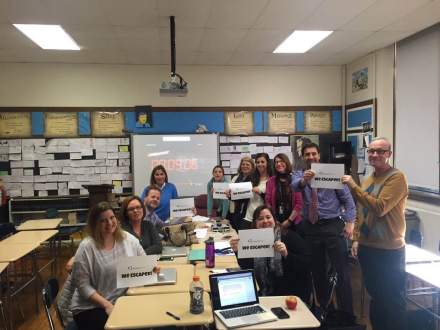
Last Wednesday my fellow teacher leaders and I were excited to find ourselves engaged in a Breakout Edu session led by Jennifer Cronk (@jenniferacronk). Breakout Edu is is a new and creative way to immerse students, and or faculty, in cooperative learning games. If you have ever heard of “Escape the Room,” it is a similar concept. The game consists of a time sensitive “quest” that revolves around one central idea and requires critical thinking and problem solving strategies.

The framework of the session involves different clues in which participants convert data into usable information to solve the puzzle. Each clue leads to data that converts into information and the team to unlock one of many locks around the Breakout Edu box. The group must unlock all of the locks before the session is over. The focus is inquiry based and learning centered.

Breakouts are being used to teach all of the different academic core subjects: math, science, history and language arts. Breakouts lend themselves to any type of team building activity, as each breakout requires collaboration to complete the challenge. Given that, Breakout Edu is also ideal for team building among the faculty or, in this instance, the school’s leadership team. Each Breakout Edu game hits each of the 21st century learning skills that are essential in today’s classroom and world. Some of the specific skills are as follows:

  • Critical Thinking/Problem Solving: The game naturally involves critical thinking and problem solving. Participants must use the very vague clues and investigate and research their meaning in order to get the codes to unlock the box. Each participant must apply real world skills to complete the challenge.
  • Collaboration & Communication: The game is naturally interactive and requires a great deal of moving parts. Participants must work together in order to complete the game on time. Within the group many participants can be working on different clues simultaneously. Communication is key in order to make sure that everyone is on the same page and the group is moving through each clue together.
  • Analysis: The clues require research and analysis. Many of the clues need to be analyzed in order to make any sense of them. For example, our key concept was “Forms of Communication” and one of our clues were a series of hieroglyphics that we had to analyze and translate into a code for a lock.
  • Initiative and Self-Direction: Breakout Edu sessions are very much “student centered.” The participants must participate and take part in order for the problem to be solved in the allotted amount of time. Each participant must use his/her strengths in order to help the team solve the problem.

In case you are wondering, we did solve the Breakout session with time to spare (9 minutes to be exact)! It was naturally engaging and fun for all of the teacher leaders. I can envision how successful this learning platform could be in any school. Have you tried Breakout Edu games or similar platforms in your schools? Feel free to share your experiences with us!

21st Century Skills: Preparing Students for College and Beyond

Guest Blogger: Candace Reim (@careim2) is the Assistant Principal and IB Diploma Administrator at Dobbs Ferry High School in Westchester County, NY.

On Tuesday of this week we were delighted to welcome a group from the graduating class of 2015 back to DFHS. This has become a tradition at our school where the previous year’s graduates come back to give advice to the current senior class. Like every year, the students talked about college life, their roommate experiences, and of course the food on campus. However, this year more than ever the alumni stressed the importance of demonstrating 21st century skills not only inside of the classroom, but also in “real world” situations, including getting along with roommates and peers as well as advocating for themselves with different professors and departments at the university. Our alumni stressed how the IB program, the science research program, and the focus on technology and 21st century skills at DFHS had prepared them to be successful in all facets of college life.

Below are the top 3 themes and skills that our alumni shared with our graduates:

1) Oral and Written Communication – In every classroom the goal of the teacher is to help students to effectively communicate both orally and in writing. Our alumni strongly emphasized the importance of being able to communicate with peers, professors, and other professionals. Whether it was communicating with their roommate about living arrangements and expectations or writing an email to a professor, the alumni emphasized the importance of properly communicating with different types of people for different purposes. One of the alumni described how she learned to write formal emails to her professors through her experiences writing formal emails to her science research mentor through DFHS.

The alumni also noted how the IB Program and the focus on the IB Learner profile in all classes in grades 9-12 helped them to be able to practice their communication skills and adapt their tone to their audience. The students also noted that the rigor and diversity of the types of writing that they experienced through the IB program helped them to be able to excel at any type of writing or assignment that was asked of them in college. One of the most striking comments from one of the alumni was, “AP kids only had essays in English and maybe history. Now we write papers for every class just as we did during our experience in our IB classes.”

2) Time Management/Adaptability – Many of the questions our current seniors had for our alumni centered around workload and time management in college. The alumni once again praised the IB Program and DFHS teachers for helping them to develop the skill of being able to effectively manage their time and deadlines. Many of the assessments in IB courses are long range assessments that require planning and extensive analysis and revisions. One graduate noted that he was “used to pacing myself through IB assignments and could develop a work and studying schedule on my own in college.” The alumni continued to describe how they needed to be sensitive to their roommate’s habits and schedule as well as plan for study groups and professors’ office hours. Being flexible and being able to effectively manage their time was a theme that continued to come up throughout the discussion.

3) Relationship Building – Lastly, and perhaps most importantly, our alumni described how critical relationship building is for success beyond high school. “This skill goes hand and hand with effective communication,” one graduate said. One of our alumni described how one of her freshman classes had 450 students so it was important for her to go to the professor’s office hours and continually communicate with him in an effort to gain the most from the experience in his class. She stated that she was able to easily approach the professor due to the types of interactions she had while here at DFHS. She stated that the teachers at DFHS always encouraged the students to advocate for themselves and communicate with them both via email and in person so that all of the students could access the class and the resources available.

Have you spoken to your past graduates about the types of skills that students need in order to be successful at the college level? Please feel free to share some of their stories!


IB MYP: Gearing Up for Authorization

I recently attended an MYP Head of School training in Baltimore in preparation for our school’s MYP authorization in the fall of 2016. I’ve written a great deal about the IB program at DFHS over the past few years and have also shared our school’s story as we move forward with the MYP in our quest to continually increase student participation and performance in the DP. I typically do a great deal of reflecting whenever I attend any training or professional development session. This time was no different. While the training itself was superb in that it allowed me to further establish an MYP network, it also provided me with an opportunity to closely examine the MYP Standards & Practices in relation to the work that we have done at DFHS to this point.

Perhaps the biggest takeaway from the training was that DFHS is working from a position of strength with regard to the MYP. I have said this from the beginning. This is due in large part to having teachers in grades 9 and 10 who have worked for years on designing learning experiences that are in-line with the IB Learning Standards. In listening to some of the obstacles that seem to “trip up” other schools as they transition to the MYP, I generated a list of takeaways that I shared with the DFHS staff at a recent meeting as a way to assess where we are as a school and where we still need to be. I connected each of these takeaways to one of the IB evaluation standards and positioned the discussion as a jumping off point for our department leaders and teachers as they plan their curriculum work for the second semester.

While I shared many takeaways with our faculty, the five listed below are perhaps the most significant and can inform both IB and non-IB schools that are considering a move to the MYP. They are as follows:

Takeaway #1–Faculty and Community Buy-In: A major challenge that so many school leaders face is with buy-in and how to get all constituencies on board with a shift to the MYP. For non-IB districts (or schools), this is a major undertaking and can require years of upfront work. While daunting, this is certainly not impossible and, if approached correctly, can lead to a clear articulation of what all members of the school community value in terms of teaching and learning. The end result might actually lead a school away from the IB and that’s okay too. At DFHS, the “buy-in” side of things was avoided since we have such a strong Diploma Program and have been clear about communicating an instructional philosophy and vision that is directly in-line with the core tenets of the IB. As a result, we have a community (and staff) who were asking why we didn’t have MYP as opposed to why we should. (Standard A: Philosophy)

Takeaway #2–Our Focus on 21st Century Skills: Our school’s focus on 21st century “survival” skills (Wagner) and the recent work that we have done around 21st century careers (see post on 12/2/15) is a fundamental component of both the IB MYP and DP. This approach has not only allowed our teachers and students to see greater meaning in our work, but has also helped to further expand our thinking beyond the school in both the present and future. IB School or not, this point is critical and is one that must be at the forefront of all curriculum development. (Standard C3: Teaching and Learning)

Takeaway #3–IB for All: What always seems to set Dobbs Ferry apart from other districts is our belief that IB is for all students instead of an “elite” group. For some, the perception may be that IB means “harder” and that some students may struggle with the IB curriculum. This is another topic that I have written about (see post 7/22/13) and is one that was raised by several school leaders at this most recent training. At DFHS, we are guided by the belief that all students are “IB students” and all engage daily with a curriculum that is guided by both the IB Learning Standards and the IB Learner Profile. Our differentiated approach, which includes a full commitment to co-teaching, has led to all-time highs in both IB DP participation and performance. Specifically, all students now enroll in at least two IB DP courses with nearly 30% of our students attaining the full IB Diploma. This “IB for all” philosophy has naturally moved to include the MYP and, as a result of our success with the DP, has been well received by teachers, parents, community members, and most importantly students. (Standard A: Philosophy; Standard B: Organization)

Takeaway #4–Having Awesome Coordinators: What new Heads of School never fully realize is the critical significance of having “rock star” IB coordinators to manage the nuts and bolts of the program. Without this, the program will flounder and will never be implemented to its greatest extent. The best coordinators are both instructional and managerial leaders. They possess all of the characteristics outlined in the IB Learner Profile while being extraordinarily detail and process oriented. At DFHS, we have two of the very best in @meghalberg (IB DP) and @MsHM2011 (IB MYP). Please do not contact them to offer them jobs…! (Standard B1: Organization)

Takeaway #5–Getting Started: For schools considering a move to the MYP, it is not necessary to wait for a “go ahead” from the IBO to start examining the standards, looking at the curriculum planners, and designing IB learning experiences for all students. Prior to our official move to the MYP, our teachers were designing units of instruction that served to directly prepare all students for the various paths that they might pursue in the IB DP. Our curriculum work was rooted in Understanding By Design (UBD) and what we found was that the MYP unit planners were modeled after the same approach. In addition, we have shifted our focus back to content-specific curriculum work and we now have numerous “MYP units” created in all of the disciplines, including fully completed interdisciplinary units in grades 9-10. With still over eight months before our official authorization visit, we are well ahead of the pace and are in a great position for this final phase of the process. (Standard C2: Written Curriculum)

Is your school considering the MYP? Please feel free to leave a comment or suggestions…!

Preparing All Students in the 21st Century: How Are We Doing?

There is so much talk these days about the skills that students need in order to be successful in the 21st century. Beyond “traditional” skills such as reading, writing, and arithmetic, the focus is now being placed on “softer” 21st century skills like problem solving, adaptability, critical thinking, collaboration, analysis, curiosity and imagination, and communication. While it’s pretty safe to assume that these same skills were necessary for success in the 20th century, what’s changed is that the job market in the 21st century is not nearly as predictable as it once was. Whereas students could once choose a profession at a young age and feel pretty comfortable that the same job would be in place for the entirety of their career, technology in the 21st century has created a landscape in which jobs are eliminated and created daily. In some ways, it’s impossible to predict and, given that, high schools often find themselves in the awkward predicament of preparing students for both everything and nothing at the same time. The result has been a high school curriculum (and school day) that is in many ways similar to what students experienced thirty years ago but differs in that the sole emphasis is now placed on preparing all students for an academic college-bound track. Long gone are the vocational programs that once prepared so many graduates with “real world” job related skills. What we are seeing instead in the best high schools is the integration of 21st century “experiences” which highlight the development of the skills believed to be necessary for success beyond the walls of the school. Examples of this include one-to-one technology, makerspaces, expanded research opportunities, and project-based learning through programs such as the IB DP and MYP. Unfortunately, these opportunities are not commonplace, particularly in urban areas, where the sole emphasis is placed on high stakes exams that in many cases assess anything but the types of 21st century skills that schools claim to value most.

While the goal of attending college is certainly a good one, the truth is that not all students should be forced to take that path. The current K-12 paradigm provides students with little to no exposure to the types of jobs that they may one day pursue or the skills needed to be successful in those respective roles. Until around the 1990s, many high schools offered vocational alternatives on site to students who wished to develop “real world” work skills that would make them immediately employable. While I’m not advocating for a revival of this model per se, it is important that high schools contextualize student learning and skill development with “real world” current and potential jobs that students might one day pursue. At DFHS, we have begun to make the shift by linking 21st century skills to current and potential 21st century jobs. This is an important shift and one that we believe will lead to richer and more complete educational experiences for all students at our school. In doing so, there are three overarching approaches for schools to consider and build upon when developing future curricula, strategic plans, and ultimately district- and school-based programs. They are as follows:  

  • Classroom Connections: “How will I ever use this? Why are we learning this?”At one time or another, every teacher has been asked these types of questions by students who roll their eyes because they see no meaning or relevance to what they are learning. I often pose these same questions to teachers in pre-observation meetings and challenge them to provide students with this added context through essential questions and examples that connect the respective topic to some type of real world application. More recently, I have begun to include a section on “21st Century Jobs” in my weekly email update to the staff. Each week I feature a new job that is either currently in existence or may one day develop and challenge the teachers to consider how, if at all, the subject that they teach helps students to develop the skills necessary for success in that respective position. I also challenge the teachers to further introduce these ideas into their lessons and to provide students with opportunities to explore and research independently. This approach will not only contextualize learning for all students, but will foster the development of curiosity and imagination (see Wagner’s “survival” skills) while inspiring deeper learning and understanding.
  • Professional Development: As noted above, the weekly emails that I send serve as a quick and informal form of professional development. Last week, the 21st century job that was featured was a “nanotechnologist” and in future weeks we will look at jobs such as robotics technicians, stem cell researchers, wind turbine technicians, cell phone developers, computer science teachers, language teachers, organic farmers, market research analysts, and car mechanics (electric and hybrid). In addition, @careim2 and I are planning to engage the whole staff in a professional development session around this topic with the hope that some our teachers will identify professionals who may come to our school or that our students might go out and visit firsthand.
  • Real World Application: While it’s important for our teachers to make the types of real world connections that are noted above, it’s perhaps more important that students have opportunities for real world application. At DFHS, we already provide students with these types of experiences through programs such as the IB DP, senior internship, science research, Creativity/Activity/Service (CAS), and Extended Essay (EE). We are also in the midst of implementing the IB MYP Personal Project and offer real world electives such as Financial Literacy, Journalism, Media Journalism, Computer Science (will offer AP next year), and OC 21 (online blended electives). Finally, @careim2 is in the early stages of exploring an extended half-year or full-year credit bearing internship program for our seniors who wish to “get out there” and learn real world skills under the guidance of an experienced mentor.

Like so many schools, we are working feverishly to keep up with the times to ensure that all of our students are best prepared for success beyond high school. Please feel free to comment and share some of the best practices that are happening at your school!

Empowering Teacher Leaders

The topic of teacher empowerment is one that I continue to come back to as the organizational structure and approach to leadership at DFHS continues to evolve and shift due to the ever-changing landscape of 21st century teaching and learning. At DFHS, we have non-administrative teacher leader positions that are filled by full-time teachers who report directly to the Principal while serving as a direct point person for the respective teachers that they are charged to “lead.” The position itself has changed over the years due to the needs of our school. While at one time the position was more managerial in nature (ordering supplies and books, etc.), the position has since shifted so that our teacher leaders are now viewed as departmental “instructional leaders” who will help to propel instruction and bring forth change in our building respective to the department that they lead.

While this shift in mindset has been exciting, there is also a learning curve for our teacher leaders as they are now being challenged to think like organizational leaders on a “micro” level. The quick assumption of course is that teachers should just get how to do that. Incorrect. As the Principal and leader of this group, it is my role to not only communicate the vision and mission of our school to our teacher leaders (and the whole staff), but to also provide our teacher leaders with the necessary professional development so that they are equipped to effectively lead in the manner that I am describing. While our teacher leaders are the content “experts,” they are not experts in leadership and require ongoing support through both whole group professional development and the individual meetings that they schedule with me.

From my perspective, investing my energy into developing our teachers into “leaders” is invaluable and the long-term organizational and instructional benefits are limitless. In working with our teacher leaders this year, there are a few key points that I continue to emphasize that are universal to leadership yet specific to the needs of our building. They are as follows:

1) Establish a Departmental Vision: While the district and school-wide vision is clear, it’s important that the departments each have a specific vision and/or “end in mind” in terms of where they hope to be in 1-year, 3-years, and 5-years. This will not only help teachers to make better meaning of the work that “needs to get done,” but will also unite the respective departments toward a common set of goals that are in-line with the vision of the overall organization. Simply stated, people need to be led by leaders who know where they are heading. Think UBD. While this is obviously true for district and building leaders, the same principle applies to departmental teacher leaders.

2) Think Like A Researcher: The challenge that I presented to our teacher leaders is to develop a plan that will bring each of our respective departments to the “next level.” What that means obviously differs across the disciplines so the charge for our teacher leaders is to first figure out what that next level even looks like within their subject area. Take a subject like science, for example: What do the best science programs look like? What is best practice in science education in terms of teaching and learning? What does the research say? What is happening in our neighboring districts? Nationally? These are the types of questions that our teacher leaders need to continue to ponder, answer, and ultimately engage teachers with in the same way that a Principal would for an entire faculty at the building level.

3) Be an Instructional Leader: As noted above, a key function of our department leaders is to essentially be a “student” of the discipline and to share best practice, training, and programs with the members of each department. The only way to do this is to stay current on the latest research, read content-specific journals each month (e.g. NCTE, NCTM, etc.), go out on site visits, attend conferences, etc. It is only through this mindset and approach that the departmental teacher will be equipped to bring forth change from both an instructional and programmatic perspective.

4) Think in Terms of Product and Skills: When planning meetings for teachers, it’s critical to consider and respect both the need for teachers to “get things done” (product) and the need to provide professional development that will help teachers to grow and improve in their practice (skills). This is an important distinction and while the two aren’t always mutually exclusive, it’s necessary to consider the differences when planning meaningful experiences for teachers and to provide opportunities for both as they relate to the respective vision of each department (and the school). At our next early dismissal three-hour department meeting, for example, our teacher leaders will split the time so that the teachers engage in both a professional activity (ex. text-based discussion around best practice) and a product-driven activity (designing IB MYP units). Both will be rooted in the “big picture” of where the departments are, where they are heading, and the work that needs to be completed right now.

5) Building Relationships: Not to be lost in any of this is the importance of building relationships in order to bring forth real change. There’s an infinite amount of literature and research on this and for administrators this is basically Leadership 101. For teacher leaders, the same concept and rules apply. While all teachers are theoretically on the same “level,” the truth is that each department has some type of unstated hierarchical structure, seniority often rules, and single members can easily undermine an idea and prevent any change from ultimately happening. So teacher leaders need to know the players, politic when necessary, and build the relationships in order to make the change happen.

My plan is to come back to this topic throughout the year and to share the work and experiences of our teacher leaders. Please feel free to tweet out (#DFHS2016) links to any articles that our teacher leaders may read and/or share with the members of their departments.

Evaluating our 1:1 Chromebook Program: Initial Takeaways

I’ve written a great deal over the past few years about our school’s one-to-one Chromebook program and the degree to which it has truly transformed teaching and learning at DFHS. This is also a topic that @careim2, @meghalberg, and I presented on at the IB Conference of the Americas (#IBChi2015) this past summer in Chicago and is one that continues to garner a great deal of interest from school leaders who are either considering or in the midst of a one-to-one program. At DFHS, we started the one-to-one not only because we believed that 21st century students could never truly learn in the 21st century without ongoing access to technology, but also because we believed that 24/7 access to technology would make it easier for teachers to differentiate while allowing for the development of Wagner’s 21st century “survival” skills. These skills are not only the types of skills that students need for success beyond high school, but are also at the heart of the IB program and capture what we value and strive for in all of our graduates.

The program has truly taken off since we started in 2013 and it has been rewarding to see all of our teachers search daily for new ways to infuse technology in a way that enhances learning in a meaningful way. Most teachers are now using Google Classroom, many classrooms are completely paperless, and students interact with teachers, peers, and community members easily and consistently through the various Google Apps that they access daily. Over the past year, I have continued to evaluate the one-to-one around the intended outcomes of the program with a specific focus on differentiation and the development of 21st century “survival” skills within the context of a high stakes testing environment. The following is a general list of five initial impressions or “takeaways” that I gathered around the one-to-one. This is by no means a complete list but rather a sample of some of the “big ideas” that I thought might be worth sharing.

1)  Implementation: All of the teachers noted that while the intended outcomes for the use of one-to-one technology were clear, a specific direction for how to implement Chromebooks was not provided and clear outcomes from a production perspective (e.g. lesson plans, Chromebook “activities,” etc.) were not directed. The Superintendent noted that this approach was intended. The lack of a clear direction from the administration in terms of desired outcomes was “liberating” for teachers. As a result, the teachers felt little pressure, felt they could move at their own pace, and found ways to utilize Chromebooks in a way that best works for them. This has led to increased teacher collaboration, professional learning, networking, and ownership.  

2)  Differentiating Teaching and Learning: While it was clear that the one-to-one provided the teachers with greater opportunities to differentiate teaching and learning, it was also clear that certain aspects of differentiation occurred much more often than others. Specifically, while differentiation happens in all forms (“content, process, or product based on readiness, learning style, or interest”), the most prevalent form is differentiating content based on student readiness. This is due in large part to the preparation that is required for high stakes examinations. In this respect, it became clear that the teachers do in fact define differentiation in a specific way.

3)  High Stakes Testing: While all teachers supported the belief that the increased student engagement in terms of curriculum and learning that occurs as a result of the Chromebooks will lead to increased performance on high stakes local and Regents exams, it is also clear that high stakes tests dictate the ways in which teachers use Chromebooks. In many instances, teachers use Chromebooks to differentiate based on content and readiness (ability) to ensure that students learn what they need to “know” in order to perform well on the final Regents exam. In courses that do not end with a Regents exam, teachers have a greater sense of freedom and provide more opportunities to pursue skills such as curiosity and imagination.

4)  21st Century Skills: It was clear that Chromebooks allow for the development of all 21st century skills beyond what is possible in a “traditional” non one-to-one environment. Of the 21st century skills, the most prevalent are adaptability and initiative (and personal responsibility) followed by critical thinking/problem solving, analysis, and communication. The least prevalent 21st century skills addressed are curiosity and imagination. This is due more to the nature of a testing environment as opposed to a lack of capability that the Chromebooks provide.

5)  Further Education: There was an expressed need among all teachers for further professional development with the use of Chromebooks and how to best enhance teaching/learning in a one-to-one environment. There is also evidence of different levels of expertise with how to best use Chromebooks to promote differentiation while furthering the development of 21st century skills within each of the respective subject areas. There is also varying levels of expertise on how to best do that. There is no specific correlation to experience with technology or overall experience. Furthermore, the type of professional development varies by teacher. Essentially, all teachers possess different levels of expertise so future professional development must be differentiated. There is also agreement among all teachers that the program has many benefits for students and on teaching and learning in general.

Of course, these just general impressions and each can easily be expanded upon at great length. Please do not hesitate to contact me if you have any questions or would like more on our school’s one-to-one story.

Moving From Good to Great: Are We There Yet?

There is nothing quite like the start of a new school year. The hallways come back to life, spirits are high, and hopes for new possibilities and opportunities are at their highest. It’s a fresh start, a reset of soughts, and it’s always a perfect time to take stock with a faculty while laying the groundwork for what the year has in store. At DFHS, we spent a great deal of time at our opening faculty meeting talking about what we have accomplished, what’s “new” at our school, and how we are doing with regard to the “good to great” question that we first tackled at our opening faculty meeting two years ago. See post:

https://johnfalino.com/2013/09/02/how-does-a-school-go-from-good-to-great/

As I enter my fifth year as the Principal of DFHS, I continue to see our journey as a story that continues to unfold. And while new teachers have joined us along the way and others have moved on, the story of our school continues to evolve. A constant for us has always been our mission to prepare all students with the necessary 21st century “survival” skills to flourish beyond the walls of our school. How we approached that five years ago versus today is of course much different, as nearly all students now have daily access to 1:1 technology, we have expanded student access to our IB and science research programs, we continue to offer new elective options both within our school and virtually, and we continue to push beyond our comfort zones to try new instructional approaches based on the respective needs of our students. It’s a pretty special place, and the question of whether I think our school is “great” is an easy one for me to answer.

So what’s it take to be a great school? I certainly think the teachers at DFHS hit the nail on the head two years ago with their ideas. After thinking some more and seeing a “great” school in action each day, I’ve come up with a few others…

1) Never Settling on “Great”: While it’s important every once in awhile for school communities  to “smell the roses” and celebrate their accomplishments, it’s equally important to engage regularly in self-assessment exercises from an organizational perspective to think about what is going well, what isn’t, and what can be done differently. As I said before, DFHS looks very different today than it did five years ago, and it will need to look much different five years from now. If it doesn’t change, and it doesn’t continue to evolve, it will not be long before that “great” school plummets to good, fair, and eventually poor.

2) Leading from the Middle: I asked the DFHS teacher leaders to read The 360 Degree Leader by John Maxwell over the summer and have since shared the text with all of the faculty members at the high school. The concept of leading “down, across, and up” from the middle of an organization is a critical mindset that all teachers need to have. At DFHS, the teacher leaders have been fully empowered to lead their respective departments in a vision building process that will result in a 1-year, 3-year, and 5-year plan. Their goal? To continue to assess the strengths and weaknesses of their departments in order to create a cutting edge program that best supports the needs of all students. My role? To support, guide, and facilitate the process and ultimate change that is needed.

3) A clear and focused vision: We have a very clear district vision in Dobbs Ferry that guides all of the work that we do at the high school. At our opening meeting I focused the teachers’ attention on Wagner’s 21st century “survival” skills with the understanding that it is our job, above all else, to prepare students for success beyond high school. Regardless of the path that our students choose upon graduating, our singular goal must be to help them to develop the necessary skills to problem solve, adapt, and flourish in any experience that they encounter. This “simple” yet incredibly complex mission supersedes all and is the foundation of all work that we do inside of the classroom each and every day.

4) Support for all students: We have lots to be proud of at DFHS. All of our students take at least two IB courses before graduating, our state exam scores are at an all-time high, and virtually all of our students engage in extra-curricular activities that range from athletics to knitting. While we are certainly proud of our “something for everyone” approach and continue to work tirelessly to ensure that all students connect to our school, perhaps what I am proudest of is the success that we have had with both our special education and economically disadvantaged students. Each year our students in these sub-groups continue to perform exceptionally well due to a systematic (and individualized) approach by our extraordinarily talented teachers and support staff. Our school also received a gold star distinction by Newsweek for our work in this area for two consecutive years.

5) Building Management: Not to be understated in any of this is the importance of having leaders who work to ensure that a school runs smoothly on a day-to-day basis. Simply stated, none of the great instructional stuff that is discussed above can happen if the operational side of things is not covered. This includes scheduling, building procedures, security, and student management. For Principals, it’s important to think Maslow and hire a good AP. I’m fortunate to work with the best in @careim2.

Of course, there are many more things that go into making a school “great” and one can probably make a dissertation topic out of this if they wanted. Please feel free to share out some additional ideas using our school’s hashtag, #DFHS2016. I wish all of you the best for a great school year.

Gearing Up for #IBCHI2015: The 1:1 Chromebook Program at DFHS

I’ve written numerous posts on the 1:1 Chromebook program at Dobbs Ferry High School over the past two years while continuing to evaluate the program for the dissertation that I plan (hope!) to finally defend this fall. I am also looking forward to sharing our school’s 1:1 story at the upcoming IB Conference of the Americas (#IBCHI2015) along with @meghalberg and @careim2. In preparation for our upcoming presentation, I have combined some of the “big ideas” from my previous posts and have added some additional insight based on my recent research. Here are the highlights…

Why Chromebooks?

  1. Practical Considerations: At first glance, the Chromebook has the look of a standard laptop. It has a 12.1-inch screen, a traditional keyboard, and opens and closes in the same way. But that’s pretty much where the comparisons end. The “web-based” Chromebook is extraordinarily light due to the absence of a standard hard drive and is also sleek in nature. This is critical for high school students who are already overwhelmed with large over-sized textbooks and book bags that weigh more than they do. In addition, the Chromebook is inexpensive as compared to even the most modest laptops that are on the market.
  2. Academic Considerations: While many of our students noted the value and benefits of using iPads as a primary device, they also noted that there is a connotation of “play” that is associated with iPads due to the thousands of non-educational apps that are available. Conversely, the Chromebook provides easy access to Google Drive and the growing number of educational apps that teachers and students are now using on a daily basis. In addition, the traditional keyboard makes much better sense than a touchpad for high school students who use the device for note-taking, paper writing, and overall collaboration.
  3. Access to Google Drive: Perhaps the greatest benefit of the Chromebook is the ease in which students can access the internet and, more importantly, Google Drive. Though still in its early stages, Google Drive has already changed the way that we think about “sharing” and is now on the cusp of changing the way that we think about teaching and learning. Through the various Google Apps for Education that are available in Drive, teachers and students can collaborate in “real time” on various projects and classroom assignments. This feature not only challenges all traditional thinking of assessing student understanding, but also how we provide ongoing feedback to students beyond the “brick and mortar” classroom.
  4. “The Cloud”: This once seemingly abstract concept has now singlehandedly changed the way that we think about accessing, saving, and sharing information. In the old days, files and documents were saved to a hard drive on a local computer or a laptop. Transferring or sharing of these files would require that we email them to another person (or ourselves) or save them to an easy-to-lose flashdrive. No more. By saving all information to “the cloud,” all files can be easily accessed on any device wherever there is internet access. With this concept in mind, the Chromebook was designed to allow users to quickly and easily access the web and their important files. Essentially, the files are available wherever you go. This is a critical for students as they can now access all documents from home or in school (or anywhere) while enjoying a virtually limitless amount of storage space.
  5. The CCSS: All of the talk these days seems to be around the new CCSS and the degree to which schools across the nation have made “the shift.” Among the many “college and career readiness” targets that our outlined in the CCSS, there is a shared expectation that students will use technology to produce, publish, interact, collaborate, and evaluate different forms of digital media. To further this point, the NCTM remarked that “unless technology is woven throughout these standards, the credibility of any claim that they will better prepare students in the 21st century is diminished.” Given these demands and expectations, the Chromebook provides easy access to databases, journal abstracts/articles via the “research tool,” and a variety of additional educational apps that are designed to enhance understanding and overall capability.

What skills have students gained as a result of the 1:1 Chromebook program?

  1. Written Communication: Teachers in all disciplines noted writing as the skill that has been most directly impacted by the 1:1 Chromebook initiative. By sharing documents both with peers and their teachers, students are now able to engage in the writing process like never before. Through formal assignments like the humanities interdisciplinary research paper (@MikeMeagh) and informal assignments such as shared journal entries (@Mrs_Fahy), students collaborate with one or more co-writers in real time through each phase of the writing process. In addition, Chromebooks allow teachers to provide ongoing feedback and targeted instruction by using the revision history feature and identifying the specific strengths and weaknesses of each individual student. In that sense, Chromebooks provide teachers with a practical tool for differentiation so that they may best meet the needs of all students.
  2. Accessing and Analyzing Information: The ease at which our 1:1 initiative has enabled students to access an unlimited amount of information on any topic via the internet has completely transformed teaching and learning in all disciplines. Teachers now play the role of facilitator on a more frequent basis while students are being encouraged to take ownership of their learning as they decipher between credible and non-credible sources on the internet. As an example, @AdamoBiology regularly has his students use the “research tool” in Google Docs to compare, contrast, and analyze abstracts, journal articles, and research studies that are available in various databases. Activities of this nature are not only in-line with both the Common Core and IB Learning Standards, but also help students to develop skills in research, evaluation, critical thinking, reading, curiosity, and self-direction.
  3. Data Analysis: In addition to the analytical skills that are developed through the activities noted above, the Chromebooks have provided our students with a new way to analyze and graphically represent numerical data through applications such as Google Spreadsheet. For example, @ANewhouse6 requires that all students share their Google “Sheet” with all of the groups in the class so that they can analyze both the validity and reliability of the data collected as well as the process and procedure that the students used to conduct their investigations. Furthermore, this feature makes it possible for students to receive instant feedback on their lab results, graphs, charts, and data analysis from both the teacher and other members of the class. As an extension, students have the ability to present their data through applications such as Google Slides. Given that, additional skills that are directly connected to data analysis include communication, organization, collaboration, and critical thinking.
  4. Initiative & Self-Direction: @sarahhmstern noted that the increased level of access to the internet has shifted the mindset of some students from feelings of  “helplessness” that come as a result of the limitations of textbooks to an understanding that all information is in fact attainable if the the proper search is conducted. This realization is especially critical when students are working independently outside of school. Similarly, teachers such as @ms_sardinia, @MicheleIrvine1, and @MegHalberg provide access to a variety of apps and websites that allow students to take control of their learning based on their specific strengths, weaknesses, and areas of interest. This includes websites such as Khan Academy and a library of Google Apps for Education.
  5. Digital Citizenship: While not a “skill” in the traditional sense, digital citizenship is critical for success in all academic classes as well as all “real world” endeavors. From an accountability perspective, students are responsible for taking care of their devices while having it in school with them each day. Furthermore, @addonam noted the importance of internet etiquette and digital citizenship with respect to searching for information and interacting with all people in a virtual setting. In that sense, the benefits for 9th graders go far beyond the classroom and indirectly connect to the development of other crucial skills, including organization, self-direction, and of course responsibility.

What are some of the issues that still need to be resolved?

  1. Instructional: Inconsistent use among teachers. While all teachers utilize Chromebooks, the degree to which they do so depends on the subject and the nature of the culminating final exam (state or local) that they are required to administer. In courses such as English, World Language, and ELL that do not end with a state exam, teachers feel a greater sense of freedom and take more risks with regard to integrating technology. Conversely, teachers in math emphasized that the end year NYS Regents exam requires “pen to paper skills” that cannot be developed via a Chromebook. Solution: Ongoing differentiated professional development that is subject specific needs to be provided. PD must always focus on the ways in which technology (and the 1:1) can enhance teaching and learning within the content areas while recognizing the specific obstacles that might exist.
  2. Instructional: Accommodating students who either forget their device at home or have a broken device. Solution: There is no perfect solution to this inevitable issue. The first and easiest solution is to have “extra” devices on hand for such situations (particularly students with broken devices). If this is not possible, teachers can find opportunities to either pair students or, if possible, allow students to access Google Drive via their phones.
  3. Instructional: Monitoring student use to ensure that all students are on task during class. Solution: In addition to the internal features in Google Drive that allow teachers to monitor student progress, our teachers noted that viewing student screens from afar is much easier with the HP Chromebook than it is with the Samsung device. We made the switch from Samsung to HP this year. There’s also a great deal to be said about the importance of teaching digital citizenship and responsible use. See “Why BYOD” (12/12/13).
  4. Infrastructure: As more students use their devices as a result of our one-to-one (grades 9-11) and/or BYOD (grade 12) initiatives, our WiFi has started to become overrun causing the internet (and downloading) to move much slower. Solution: Increase bandwidth and access points. In many ways this is still a work in progress for us as we determine the appropriate amount of bandwidth to support such a high level of activity. On our campus (MS/HS), we can have as many as 1300 devices connecting to the network at one time. Given that, we have moved from 40 MHz to 100 MHz and have installed 115 access points throughout the district. Despite these changes we still have instances when the internet moves slowly so it something that we continue to evaluate.
  5. Infrastructure: The battery often drains before the of the end of the day even if the devices are fully charged overnight. Solution: We are finding that some of the biggest battery “drains” occur during student “free” periods (lunch, etc.) when they access gaming and movie sites. Speaking to students about this issue is key and, if necessary, blocking sites as needed. In addition, charging stations need to be provided throughout the building and all student chargers should be labeled (name/grade level) so that students can use their chargers while at school.

For more information, we invite you to attend our session at 11:15 on Saturday, July 25 in the “Missouri” room!